
TL;DR
A Fit&Well report says a common beginner mistake is attempting advanced Pilates variations before learning the fundamentals. Certified instructor Marina Enright recommends controlled movement, attention to breathing and easier modifications; people with injuries or specific goals may benefit from guidance from a certified instructor.
A Fit&Well report on beginner Pilates warns that people can make the mistake of choosing advanced exercise variations before establishing a strong foundation. Certified instructor Marina Enright says rushing into harder moves can lead people to recruit the wrong muscles and place unnecessary tension on the neck, shoulders or lower back.
Enright, founder of Amare Pilates, told Fit&Well that beginners may be tempted to copy demanding moves they see instructors perform on social media. But those exercises can require a level of core strength and control that a new participant has not yet developed. The report does not identify a survey or study behind its description of this as a common mistake; the warning is presented as Enright’s professional advice.
Her first recommendation is to prioritize movement quality over repetition count. Enright advises moving slowly and with control, maintaining alignment and focusing on the muscles intended for the exercise rather than selecting the most difficult version. She also recommends paying attention to breathing during movement, which she says can support core engagement, control and body awareness.
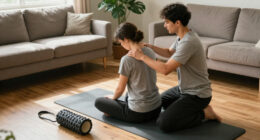
Enright’s third tip is to use modifications rather than treating them as a lesser option. Easier versions can help beginners learn a movement’s fundamentals while building strength, she says. For people working toward a specific goal or recovering from an injury, she recommends seeking help from a certified Pilates instructor who can offer alignment feedback and individualized modifications.
Why Slower Progress Can Help
The advice matters because choosing an exercise that exceeds a person’s current control can shift effort to areas that are not meant to carry it. Enright says compensating with other muscle groups can create unnecessary tension, particularly in the neck, shoulders and lower back. She says repeatedly practicing those patterns may reinforce poor movement habits and could contribute to discomfort or injury over time.
The report does not say that attempting an advanced move will inevitably cause harm. Its practical point is that difficulty is not the same as effective practice: a less demanding variation performed with control may help a beginner learn the movement more reliably than an advanced version performed without the required foundation. Modifications can also make it easier to adjust a workout to current ability.
For readers following workouts online, the distinction is useful: an instructor’s polished demonstration does not show whether the same variation is appropriate for a beginner. Enright’s guidance is to choose a version that allows steady control and sound alignment, and to ask a qualified instructor for personalized help when a goal or injury makes general guidance insufficient.
As an affiliate, we earn on qualifying purchases.
The Basics Behind Enright’s Advice
The Fit&Well report focuses on beginner decisions when starting Pilates, particularly the gap between advanced-looking exercises shared online and the foundational control those movements may require. It does not name a particular workout, platform or move; the concern is the broader tendency to imitate a difficult variation before learning a simpler one.
Enright’s three recommendations are connected: practice with control, coordinate breathing with movement and modify exercises when needed. The report presents these as instructor guidance rather than as findings from a clinical trial or a formal review of Pilates injuries. It also does not claim that one approach suits every participant.
Pilates resistance bands for beginners
As an affiliate, we earn on qualifying purchases.
As an affiliate, we earn on qualifying purchases.
Limits of the Available Advice
The source is a report conveying one instructor’s recommendations, not a study establishing how often beginners choose advanced variations or measuring the risk of injury. It provides no data on the frequency of Pilates-related discomfort, and it does not compare injury outcomes between people who modify exercises and those who do not. The description of the mistake as widespread should therefore be understood as the report’s framing, not a quantified finding.
Enright’s comments also do not establish which variation is appropriate for every reader. The report does not specify how long beginners should practice fundamentals before progressing, or provide a test for deciding when they are ready. People with an injury or other individual concerns may need advice tailored to their circumstances.
Pilates foam roller for muscle recovery
As an affiliate, we earn on qualifying purchases.
As an affiliate, we earn on qualifying purchases.
How Beginners Can Apply the Tips
The report offers no announced follow-up study or formal progression schedule. Its immediate recommendation is to begin with a variation that can be performed slowly and with control, pay attention to breathing, and use an easier modification when the full version compromises alignment or control.
Beginners who are unsure how to adapt a move can ask a certified Pilates instructor for feedback. Enright specifically recommends instructor support for people pursuing a particular goal or recovering from an injury. The source does not provide medical advice or a substitute for assessment by an appropriate health professional.
Pilates instructional DVD for beginners
As an affiliate, we earn on qualifying purchases.
As an affiliate, we earn on qualifying purchases.
Key Questions
What mistake does the report say Pilates beginners often make?
It identifies choosing advanced exercise variations too soon, before developing a foundation in strength and control. This is advice attributed to instructor Marina Enright, not a measured finding about how many beginners make the mistake.
What should a beginner focus on instead?
Enright recommends slow, controlled movement, proper alignment and quality rather than a high number of repetitions. She also advises paying attention to breathing and selecting a version of the exercise that can be performed with control.
Are easier Pilates modifications a sign of weakness?
No. Enright says modifications help beginners learn the fundamentals and build strength. The report presents them as a normal way to adapt exercises to a person’s current ability.
Should someone with an injury get individual guidance?
Enright recommends working with a certified Pilates instructor for people recovering from an injury or pursuing a specific goal. The source does not assess individual injuries; readers with health concerns should seek guidance appropriate to their situation.
Source: rss