TL;DR

Get comfort and recovery gear delivered free with Prime
- Fast, free delivery on millions of items
- Prime Video, Amazon Music and more included
- Member-only deals all year
Fit&Well reported that physical therapist Dr. Marivi Lao recommends a figure-four stretch, a kneeling hip-flexor stretch and a supine hip twist for people looking to work on hip mobility. She advises starting with one to three repetitions held for 20 to 30 seconds per side, two to four times weekly, and stopping short of pain or forcing a position.
Physical therapist Dr. Marivi Lao recommends three gentle stretches—a figure four, kneeling hip-flexor stretch and supine hip twist—for people seeking to work on hip mobility, according to a Fit&Well report. Lao says prolonged sitting can leave the hips feeling stiff, but advises moving regularly and treating the routine as a comfortable range-of-motion practice, not a test of flexibility.
Lao, who works with Spear Physical Therapy, suggests beginning with one to three repetitions of each stretch, held for about 20 to 30 seconds per side, two to four times a week. She says people who enjoy stretching and find it comfortable may include the routine in a daily schedule. These are her recommendations, not a claim that the stretches will produce the same result for everyone.
For the figure four, lie on your back with knees bent, cross one ankle above the opposite knee, lift the supporting foot and gently draw that thigh toward your chest. Lao says the stretch should be felt mainly around the glute and outer hip. Keep the crossed foot flexed and relax the shoulders and pelvis; if the position causes knee discomfort or a pinching feeling in the hip, ease off or adjust. A bed can be used if getting onto the floor is difficult.
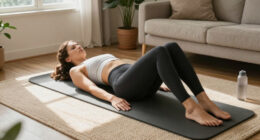
For the kneeling hip-flexor stretch, place one foot forward with the knee bent, gently tilt the pelvis and shift forward until there is a stretch at the front of the opposite hip. Lao recommends squeezing the glute on the kneeling side. She warns against arching the lower back or pushing the hips forward to force a deeper position. The third move, the supine hip twist, involves lying with knees bent and slowly lowering them from side to side for 20 to 30 seconds. Lao describes it as gently exploring rotation, rather than trying to make the knees touch the floor. It can also be done on a bed.
How to Stretch Without Forcing Range
The advice focuses on comfortable movement rather than achieving a particular range or touching the floor. That distinction may help readers avoid turning a simple mobility routine into a competition or pushing into positions that cause discomfort. Lao says people should feel a gentle-to-moderate pull, not pain.
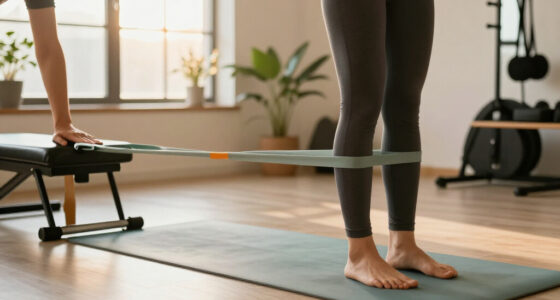
She also recommends pairing stretching with hip-strengthening exercises, giving resistance-band marches as one example. The source does not present evidence that these three stretches prevent injury, treat a condition or work equally well for everyone. Their relevance is practical: the instructions offer a low-complexity routine and cues for easing back when movement feels forced.
As an affiliate, we earn on qualifying purchases.
Why Sitting Can Feel Restrictive
Lao says that when people sit for hours, their hips stay bent for a prolonged period, and some may notice stiffness or tightness when standing at the end of the day. She recommends moving around regularly as well as trying targeted stretches. The report does not establish that sitting is the cause of every person’s hip discomfort, or that stretching alone will address it.
Lao defines mobility as having enough comfortable range of motion to get through daily activities without feeling restricted. Her suggested schedule—two to four times weekly—is a starting point, while daily practice is an option for people who enjoy it and find it comfortable. The report offers no comparative study or outcome data for the routine.
“A good starting point is doing one to three repetitions of each stretch, holding for about 20-30 seconds per side, two to four times per week.”
— Dr. Marivi Lao, physical therapist with Spear Physical Therapy
As an affiliate, we earn on qualifying purchases.
Limits of the Stretching Advice
The report does not specify a publication date, cite a clinical trial of this exact routine or provide measured outcomes. It is therefore unclear how much benefit an individual should expect, how quickly changes might occur, or whether the stretches are appropriate for a particular injury or medical condition. Lao’s suggestions are general guidance, not an individualized assessment.
The source also does not set out criteria for when persistent pain or restricted movement should be assessed by a clinician. It does advise backing off if a stretch causes pain, pinching, breath-holding, whole-body tension or a struggle to move farther. Readers with existing symptoms or conditions may need professional advice before starting or changing an exercise routine.
As an affiliate, we earn on qualifying purchases.
Adjust the Routine to Your Body
Lao’s next step for readers is to try the movements gently, stay within a comfortable range and adjust or stop if symptoms arise. People can begin with the suggested 20-to-30-second holds and one to three repetitions, then decide whether the routine feels suitable. The report does not announce a follow-up study or a scheduled next development; it presents the stretches as practical guidance readers can apply at their own pace.
For the kneeling move, the source offers a standing lunge version as an alternative. The figure-four and supine twist can be done on a bed by people who find it difficult to get down to the floor. Lao also suggests pairing mobility work with strengthening, such as resistance-band marches, while emphasizing that the movements should not be forced.
As an affiliate, we earn on qualifying purchases.
Key Questions
Which three stretches does the physical therapist recommend?
Dr. Marivi Lao recommends the figure-four stretch, a kneeling hip-flexor stretch and a supine hip twist.
How often should the stretches be done?
Lao suggests starting with one to three repetitions, holding each for about 20 to 30 seconds per side, two to four times a week. She says daily practice is an option if stretching feels good and suits the person.
Should a stretch hurt to be effective?
No. Lao advises aiming for a gentle-to-moderate pull, not pain. Pinching, breath-holding, excessive tension or forcing the position are cues to ease off or adjust.
Can the stretches be done without getting on the floor?
The report says the figure-four and supine hip twist can be done on a bed. A standing lunge version can replace the kneeling hip-flexor stretch.
Are the stretches a treatment for hip pain?
The report presents them as general mobility exercises, not as a treatment for a medical condition. It does not provide individualized advice or evidence that they will resolve pain. Anyone with ongoing symptoms or a pre-existing condition may want to consult a health professional.
Source: rss
Halloween Picks
halloween
As an affiliate, we earn on qualifying purchases.