TL;DR

Get comfort and recovery gear delivered free with Prime
- Fast, free delivery on millions of items
- Prime Video, Amazon Music and more included
- Member-only deals all year
Physiotherapist Helen O’Leary shared four standing Pilates exercises for people who struggle with floor-based workouts: a standing book opener, scooter, marching and hip abduction. The moves focus on mobility, balance and core stability, according to the Fit&Well report; individual results and suitability will vary.
Physiotherapist Helen O’Leary, clinical director at Complete Pilates, has recommended four standing Pilates exercises for people who struggle to exercise on the floor. In a Fit&Well report, she said upright moves can challenge balance, core strength and mobility without requiring a mat-based position.
O’Leary’s suggested routine includes a standing book opener, a scooter, marching and standing hip abduction. The exercises use body weight and can be done at home; the report gives suggested sets or repetitions for each rather than presenting them as a formal class or individualized program.
For the book opener, stand with feet about hip-width apart and hands behind the head, then rotate the rib cage and head to each side. The report suggests three sets of four to five repetitions per side. O’Leary advises keeping the pelvis facing forward to encourage a more controlled turn.
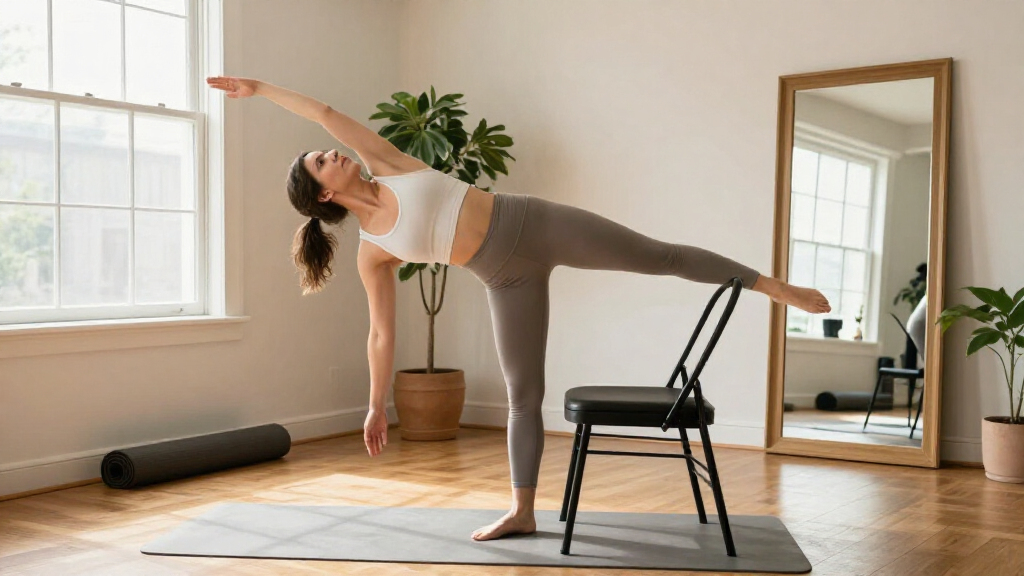
The scooter involves shifting weight onto one leg and sliding the other foot back and forward, with the toes staying on the floor. The report suggests three rounds of 10 to 15 repetitions per side. Marching uses the same suggested rounds and repetitions: stand on one leg, lift the other, lower it, then switch. For hip abduction, stand on one leg and move the other straight leg out to the side, with a recommendation of up to three rounds of 10 repetitions per side. A chair, table or counter can provide support for balance; a sock or towel under the moving foot may help with the scooter on a wooden floor.
An Upright Option for Exercise
The recommendations offer an alternative for people who find it uncomfortable, difficult or inaccessible to get down onto a mat. The four exercises can be performed while standing and use a nearby surface for support, which may make them easier to adapt to a home setting. They do not require Pilates equipment, according to the instructions in the report.
O’Leary says standing work can challenge the body differently from floor-based moves. She identifies core strength and balance as demands of the routine, while the report describes the exercises as aimed at mobility, balance and core stability. Those are the instructor’s explanations of the exercises, not evidence that the routine will produce a particular health outcome for every person.
The practical details matter for people trying the moves: repetitions are suggestions, support is allowed, and the hip-abduction instructions say to lower the leg if balance begins to fail. The report does not establish that this four-move set is suitable for everyone or a substitute for a tailored exercise plan.
Products Worth Considering

Fitbit Versa Smart Watch – Black Aluminum, One Size (S & L Bands Included)

Fitbit Versa 2 Health and Fitness Smartwatch with Bonus Bands

Fitbit Sense Advanced Smartwatch – Sage Grey/Silver (One Size, S & L Bands Included)
As an affiliate, we earn on qualifying purchases.
How the Four Moves Work
Pilates is often associated with mat exercises or equipment such as a reformer, but the Fit&Well report presents standing work as another format. The emphasis here is not on a new piece of equipment or a clinical study; it is an instructor’s selection of exercises for people who prefer not to work on the floor.
The moves combine different actions. The book opener rotates the upper body while the pelvis stays forward; the scooter shifts weight while one foot slides; marching lifts one knee at a time; and hip abduction moves a straight leg sideways. Together, those instructions involve rotation, weight transfer and leg movement, with balance support recommended where needed.
O’Leary also links standing sessions with posture and the effects of prolonged sitting. Those points are her explanation in the report, rather than findings from a study cited in the supplied material. The article provides no comparison of standing and floor Pilates, and no data measuring changes in posture, strength or mobility.
“Standing Pilates exercises might sound as though they’re easy, but they test you in many ways that floor-based moves won’t.”
— Helen O’Leary, physiotherapist and clinical director at Complete Pilates
Limits of the Exercise Guidance
The report does not specify when it was published in the supplied source material, nor does it provide research data on the four exercises or a comparison with floor-based Pilates. It also does not say how quickly a person might notice changes, how often to perform the routine, or whether the moves are appropriate for someone with a particular injury, condition or mobility limitation.
The repetition counts are general suggestions attributed to the report, not individualized instructions. People who experience pain, feel unsteady, or have a health condition that affects exercise may need advice from a qualified health professional before trying the movements. The source does not provide a full warm-up, cool-down or progression plan.
Adapting the Routine Safely
The report does not announce a follow-up study, program or next publication milestone. For readers interested in trying the movements, its immediate guidance is to use a stable nearby surface for support during marching or hip abduction and to keep the scooter’s moving toes on the floor. The hip-abduction instructions advise lowering the leg when balance starts to fail.
Any next step depends on the individual: the source gives no universal schedule for repeating the set. People can use the suggested repetitions as a reference, adjust movement range to their ability and stop if a movement causes pain or unsafe loss of balance. Those with existing health concerns can seek individualized guidance from a qualified professional.
Key Questions
Which standing Pilates moves did Helen O’Leary recommend?
She recommended a standing book opener, scooter, marching and standing hip abduction, according to the Fit&Well report.
Do the exercises require Pilates equipment?
The instructions use body weight and do not call for a reformer or other Pilates equipment. A chair, table or counter can be used for support. The report suggests a sock or towel beneath the moving foot for the scooter on a wooden floor.
How many repetitions does the report suggest?
It suggests three sets of four to five book openers per side, three rounds of 10 to 15 scooter repetitions and marches per side, and up to three rounds of 10 hip abductions per side. These are general recommendations in the report, not a personalized prescription.
Are standing Pilates exercises suitable for everyone?
The report presents them as an option for people who struggle with floor exercise, but it does not establish that they are suitable for everyone. Someone with pain, balance concerns or a health condition affecting exercise may want to ask a qualified health professional for individualized guidance.
Source: fitandwell.com