TL;DR

Get comfort and recovery gear delivered free with Prime
- Fast, free delivery on millions of items
- Prime Video, Amazon Music and more included
- Member-only deals all year
Fit&Well published a four-move recovery yoga flow created by Yogalina Studios founder and teacher Alina Boyett. The equipment-free sequence is intended for beginners and includes guidance to move gently, avoid painful stretches and seek professional advice when injury or medical conditions are relevant.
Fit&Well has published a four-move recovery yoga flow created by Alina Boyett, founder of UK-based Yogalina Studios, for people seeking gentle movement after exercise or a day spent sitting. The sequence requires no equipment or prior yoga experience, and Boyett advises readers to move within a comfortable range rather than force a stretch or continue through pain.
The routine pairs four restorative movements with short holds and controlled breathing: Waterfall pose, Child’s pose, a Ragdoll forward fold and a Seated spinal twist. Boyett said she selected the poses to address areas that can feel tense after activity, including the legs, hips, spine and shoulders. Yogalina teacher Misha Clarke demonstrates the sequence in a video accompanying the report.
For Waterfall pose, lie on your back near a wall and rest both legs against it, keeping the knees slightly bent if that feels more comfortable. Relax the shoulders, arms and jaw, and stay for three to five breaths. Boyett describes the position as a way to rest tired legs; she says elevating them may reduce a feeling of heaviness while encouraging relaxation. These are her descriptions of the pose, not reported clinical findings.
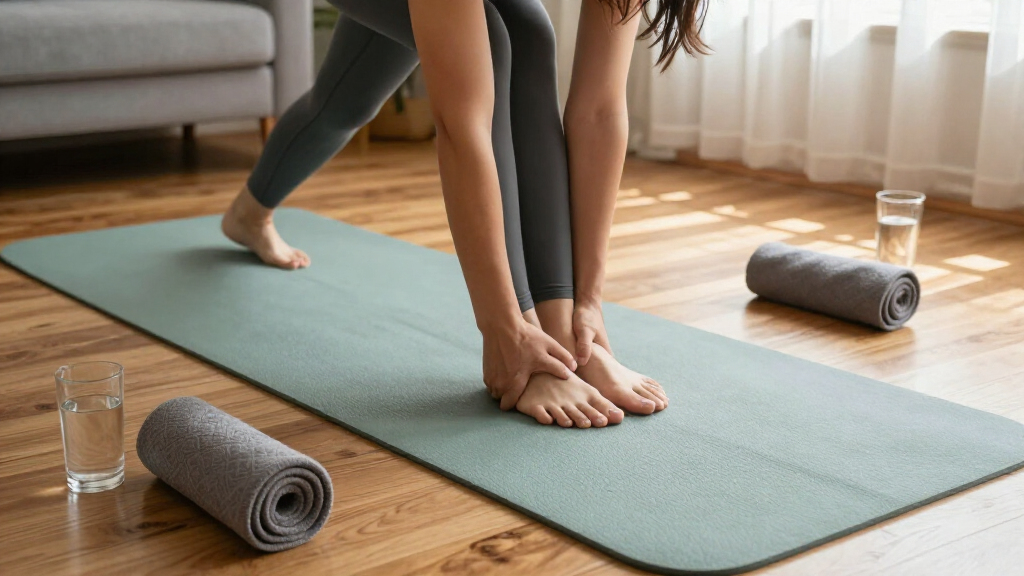
Child’s pose begins on hands and knees. Bring the big toes together, separate the knees gently, and lower the hips toward the heels before reaching the arms forward. Rest the forehead on the floor if comfortable and breathe slowly for three to five breaths. For the Ragdoll fold, stand with feet hip-width apart, soften the knees and fold from the hips. Let the head and arms hang, optionally holding opposite elbows and swaying gently; return to standing slowly. Fit&Well lists two sets of three to five breaths for this pose.
To finish, sit with legs crossed or extended, lengthen the spine and gently rotate the upper body to one side, using a hand behind the body and the opposite hand on the knee. Return to center and repeat on the other side. The listed guidance is two sets of two to three breaths per side. Boyett says gentle rotation can support back and torso mobility, particularly after repeated movement or prolonged sitting.
A Short Routine for Rest Days
The report focuses on recovery as part of an exercise routine, rather than presenting the sequence as a workout or a treatment. Boyett told Fit&Well that recovery means giving the body what it needs, not simply doing nothing. The practical value for readers is a brief, low-equipment option they can try at home after a run, challenging workout or extended time at a desk.
The sequence is designed to be approachable: its poses do not require advanced flexibility, and the suggested holds are measured in breaths rather than lengthy intervals. That may make it easier for a beginner to follow, while the instructions to soften the knees and avoid forcing movement leave room to adapt the positions. The report does not establish that the flow prevents injury, speeds physical recovery or produces a specific health outcome.
Its broader message is that gentle movement and rest can sit alongside regular training. Boyett encourages readers to slow down and pay attention to how their bodies feel. That advice can help readers approach the routine more cautiously than a performance-focused stretch session, but comfort and individual circumstances still matter.
Products Worth Considering

Garmin Forerunner 55 GPS Running Smartwatch, Black

Oura Ring 4 Smart Ring – Silver – Size 8

Garmin Forerunner 70 GPS Running Smartwatch, 43 mm, Black
As an affiliate, we earn on qualifying purchases.
How the Four Poses Fit Together
Fit&Well’s report presents the sequence as a response to two everyday situations: physical activity and prolonged sitting. Boyett says both can leave people wanting to stretch or slow down. The article does not describe a new clinical study or a formal exercise program; it is a practical routine attributed to a yoga teacher and shared with readers through instructions and a demonstration video.
The four positions move from resting with the legs supported, to a kneeling forward fold, to a standing fold and then a seated rotation. Their stated focus shifts across the legs, hips, back, shoulders and torso. The report suggests about three to five breaths for the first three poses and two to three breaths per side for the twist, with one or two sets specified for each movement. Readers can follow the instructions in order, but the source does not state that a particular duration or sequence is required for everyone.
Boyett’s comments are the main source for the routine’s intended benefits. Fit&Well attributes claims about relaxing, easing tension and supporting mobility to her, rather than citing measurements or independent testing. The article therefore supports describing the flow as gentle and beginner-oriented, but not as a proven way to relieve a medical condition.
Limits of the Reported Benefits
The source offers no clinical research, measurements or comparison group to show whether this particular flow reduces soreness, improves flexibility or changes recovery time. Boyett’s descriptions of the poses, including easing tension and helping tired legs feel less heavy, are attributed to her and should not be read as established outcomes for every practitioner.
Fit&Well does not provide a publication date in the supplied material, and it does not state how long the routine takes overall. Some poses may also need adjustment depending on a person’s mobility, comfort or health. Boyett advises anyone with an injury or relevant medical condition to seek appropriate professional guidance before trying the sequence. The report does not give individualized modifications for those circumstances.
How Readers Can Approach the Flow
The immediate next step for readers interested in the routine is to review Fit&Well’s instructions and Clarke’s demonstration, then move through the poses slowly in a space where the positions feel comfortable. Boyett recommends stopping rather than pushing through pain; readers should use a gentler range or skip a movement if it does not feel suitable. Anyone managing an injury or a relevant medical condition should consult an appropriate professional before beginning.
The source does not announce a follow-up study, trial or further update. For now, the sequence remains a teacher-created routine published as wellness guidance, not a tested treatment plan. Whether it feels helpful will depend on the individual, and the report provides no promised results or timeline for changes in flexibility.
Key Questions
What is the yoga flow featured by Fit&Well?
It is a four-pose recovery sequence created by Alina Boyett: Waterfall pose, Child’s pose, a Ragdoll forward fold and a Seated spinal twist.
Does the routine require equipment or yoga experience?
Boyett describes it as suitable for beginners and says it requires no equipment or previous yoga experience. The Waterfall pose uses a wall for support.
How long should each pose be held?
The instructions list three to five breaths for Waterfall and Child’s pose, two sets of three to five breaths for the Ragdoll fold, and two sets of two to three breaths per side for the twist.
Is the flow proven to relieve tight muscles or improve flexibility?
The report shares Boyett’s guidance and descriptions but provides no clinical evidence or measured results for this specific sequence. Its effects may differ from person to person.
Who should seek advice before trying the sequence?
Boyett advises people with an injury or relevant medical condition to seek appropriate professional guidance. The instructions also say not to force a stretch or push through pain.
Source: fitandwell.com