TL;DR

Get comfort and recovery gear delivered free with Prime
- Fast, free delivery on millions of items
- Prime Video, Amazon Music and more included
- Member-only deals all year
Fit&Well published a beginner Pilates routine from instructor Sammy Taylor, featuring five bodyweight moves and easier options for each. Taylor advises practicing two to three times a week, starting with one round and resting 15 to 20 seconds between exercises.
Fit&Well has published a five-exercise Pilates routine for beginners, with instructor Sammy Taylor offering modifications for people who find parts of the movements difficult. The bodyweight sequence is designed to take about 10 minutes for one round and works the core and glutes while practicing controlled movement and mobility.
The routine includes a glute bridge, dead bug, side-lying leg lift, bird dog and Pilates roll down. Fit&Well describes Pilates as low-impact and adaptable, and reports that Taylor specializes in working with people who have neurological conditions and limited mobility. Those details provide context for the suggested adjustments, but do not establish that every move is suitable for every person or condition.
For a first session, Taylor recommends completing one round of all five exercises, with 15 to 20 seconds of rest between movements. She says this should take around 10 minutes; people who become comfortable with the sequence can build up to two rounds. Her suggested practice frequency is two to three times a week, at an individual pace.
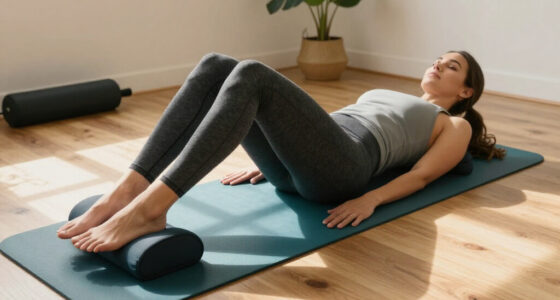
The repetition ranges vary by exercise: eight to 10 glute bridges, six to eight dead bugs per side, eight to 10 side-lying leg lifts per side, six to eight bird dogs per side and four to five roll downs. The source emphasizes controlled movement and gives easier alternatives, rather than setting a performance target or promising a particular result.
How the Routine Adapts Each Move
The main practical feature is that each exercise has a lower-demand option. For a bridge, a beginner can lift the hips only slightly or practice a pelvic tilt without lifting. In the dead bug, the starting adjustment is to keep both feet down and slide one heel at a time, or move only the legs. These variations let readers scale the movements instead of treating the full version as a requirement.
Other adjustments address balance, range of motion and position. A side-lying leg lift can be made smaller, with the bottom leg bent for support. Bird dog can be practiced by sliding one leg back, lifting one arm at a time or, if kneeling is uncomfortable, reaching an arm while seated in a sturdy chair. For the roll down, the source suggests sliding the hands along the thighs or trying a small seated curl. These are options for modifying the routine, not individual clinical guidance.
For readers new to Pilates, the short format makes the sequence easy to follow without equipment, according to the report. The exercises move between lying, side-lying, hands-and-knees and standing positions, so the routine still involves changing posture. A nearby chair or wall is recommended for support during the standing roll down.
Products Worth Considering

BowFlex Results Series SelectTech Adjustable Dumbbells, Pair

Therabody Theragun Mini 3rd Generation Massage Gun, Black

Therabody TheraFace Mask Glo Cordless LED Skincare Mask
As an affiliate, we earn on qualifying purchases.
Taylor’s Five-Move Beginner Sequence
The routine is presented by Fit&Well as a beginner option that uses bodyweight rather than equipment. Its five movements cover different positions and actions: lifting the hips, coordinating opposite arm and leg movement, raising a leg while lying on one side, reaching from hands and knees, and gradually curling the spine while standing.
Fit&Well attributes the guidance to Sammy Taylor, a Pilates instructor whose reported work includes people with neurological conditions and limited mobility. The article does not provide a clinical study or compare this sequence with other beginner programs. Its recommendations should be read as an instructor’s routine published by a fitness outlet, rather than evidence that the exercises treat a health condition.
“Practice it two to three times a week, moving at your own pace and using the easier options whenever needed.”
— Sammy Taylor, Pilates instructor, as quoted by Fit&Well
Limits of the Published Guidance
The source does not state when the routine was published, provide independent testing of its effects or specify how quickly a beginner might notice changes in strength or mobility. The phrase “best” is the article’s framing; the supplied material does not show a comparison with other Pilates routines. It also does not establish that the sequence is appropriate for every person, including people with injuries or medical conditions.
Readers should stop if a movement causes pain or unusual symptoms. Anyone with an injury, a neurological condition or another health concern may want to ask a qualified health professional or instructor about suitable modifications before starting. The article offers general options, not a personalized assessment.
Starting With One Comfortable Round
For someone choosing to try the routine, the next step described by Taylor is to complete one round at a comfortable pace, resting 15 to 20 seconds between exercises and using the simpler versions as needed. The sequence is intended to take about 10 minutes. Taylor suggests increasing to two rounds only if the first feels manageable.
Fit&Well provides no further milestone, follow-up assessment or schedule for progressing beyond two rounds. Readers can use the exercise ranges and modifications as a starting structure, but should adjust or stop if the positions are uncomfortable. The report does not say that completing the routine will produce a specific fitness outcome.
Key Questions
What exercises are in the beginner Pilates routine?
The five movements are a glute bridge, dead bug, side-lying leg lift, bird dog and Pilates roll down.
How often does the instructor recommend practicing?
Sammy Taylor advises practicing two to three times a week, moving at an individual pace and using easier variations when needed.
How long does one round take?
Fit&Well estimates that one round of all five exercises takes about 10 minutes, with 15 to 20 seconds of rest between movements.
Can the exercises be modified?
Yes. The routine gives alternatives such as smaller movements, sliding a heel or leg instead of lifting it, and practicing an arm reach while seated if kneeling is uncomfortable. These are general modifications, not tailored medical advice.
Is this routine suitable for everyone?
The report presents it as a beginner routine but does not establish that it is appropriate for every person or health condition. Anyone with an injury or medical concern should seek guidance from a qualified professional, and stop if an exercise causes pain or unusual symptoms.
Source: fitandwell.com